
Planning for a 0% Tax Bracket in Retirement
Power of Zero in Dallas–Fort Worth: Tax-Smart Retirement Planning
We help Metroplex households reposition retirement savings toward the 0% tax bracket, because the size of your 401(k) means very little until you know what share of it is actually yours.
Why Your Retirement Savings May Not Be Entirely Yours
If most of your nest egg lives inside a 401(k), 403(b), or traditional IRA, there's something important to understand: that money has never been taxed. Every dollar you contributed went in pre-tax, and every dollar you withdraw in retirement will come out as ordinary income — taxed at whatever the rates happen to be at that time.
That last part is the problem. Nobody can tell you with certainty what tax rates will look like ten, twenty, or thirty years from now. What we do know is that the national debt continues to climb, and the interest alone on that debt now rivals some of the largest line items in the federal budget. Many economists and retirement researchers believe that future tax rates will need to rise — perhaps significantly — to keep pace with those obligations.
Which raises an uncomfortable question: If you don't know what portion of your retirement accounts will ultimately go to taxes, do you really know how much you've saved?
The current U.S. national debt:
$…
Source: U.S. Treasury, Debt to the Penny · live estimate based on recent Treasury data
Our Approach: Working Toward the 0% Tax Bracket
We use a planning process designed to answer that question — by systematically repositioning assets and income streams over time with the goal of reducing, and in some cases eliminating, your taxable income footprint in retirement.
The logic is simple: when you're in or near the 0% tax bracket, the direction of future tax rates matters far less to your retirement security. If rates rise, your plan doesn't flinch. Because no matter how high taxes climb, a percentage of zero is still zero.
This strategy draws on the framework popularized by David McKnight, bestselling author of The Power of Zero and Tax-Free Income for Life.
Through our strategic alliance with the David McKnight group, we have access to specialized planning software, tools, and training that help us guide clients along the road to tax-free retirement income.
What the Road to Zero Actually Examines
Every plan is different. The work almost always runs through the same five questions.
Where your money lives today, across taxable, tax-deferred, and tax-free accounts, and how that balance shapes your future tax bill.
Whether shifting dollars from tax-deferred to tax-free accounts now, at rates you can see, makes sense for your situation.
The order in which you draw from accounts, which can meaningfully change your lifetime tax cost without changing a single investment.
Required minimum distributions, which currently
begin at age 73 and move to 75 in 2033, and whether forced withdrawals will push you into a higher bracket later.
Tax-advantaged income sources that can produce retirement income without adding to your taxable footprint.
Roth conversions are usually the central lever, and they work best spread deliberately across multiple tax years rather than executed in one. Note that Roth IRAs and designated Roth accounts in a 401(k) or 403(b) carry no required minimum distributions during the owner's lifetime, which is a large part of why repositioning matters.
That last bullet is where product decisions enter, and we evaluate
annuities on the same terms as anything else, as one possible tool rather than the point of the exercise. Repositioning also interacts directly with how your portfolio is managed, which is why this work runs alongside our
wealth management service.
Recommended Reading
Want to explore the road-to-zero philosophy in depth? Start with these two bestsellers from David McKnight, whose framework informs our approach. Both books tackle the same uncomfortable truth — that future tax rates are the biggest unknown in your retirement plan — and lay out practical, step-by-step strategies for protecting your savings from it.
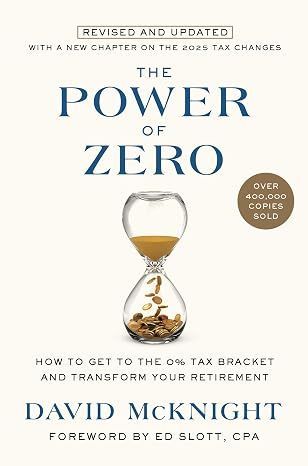
The Power of Zero
How to Get to the 0% Tax Bracket and Transform Your Retirement by David McKnight
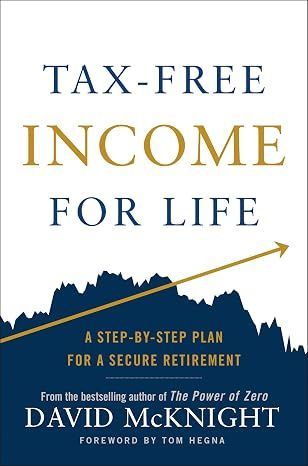
Tax-Free Income for Life
A Step-by-Step Plan for a Secure Retirement by David McKnight
Video Resources
Prefer to watch instead? These videos break down the Power of Zero philosophy, the tax challenges facing traditional retirement accounts, and the strategies for reaching a tax-free retirement.
What People Want to Know Before They Start
What is the Power of Zero retirement strategy?
It's an approach to retirement planning built around getting your taxable retirement income as close to zero as possible, so that future tax rates stop being a threat to your plan. The reasoning is straightforward: a percentage of zero is zero no matter how high rates climb. The framework was popularized by David McKnight, and we use it as a planning discipline rather than a product pitch.
How do you get to the 0% tax bracket in retirement?
Generally by moving money out of tax-deferred accounts over a period of years while rates are known, paying the tax deliberately along the way, and building income sources that don't add to your taxable total. Standard deductions and the taxable thresholds on Social Security do real work here too. It's a multi-year sequence, not a single transaction.
Should I do a Roth conversion, and how much?
The amount usually matters more than the decision. Converting too much in one year can push you into a higher bracket, increase the taxable portion of your Social Security, and raise your Medicare premiums two years later. We model the conversion against those effects year by year and convert only up to the point where the next dollar costs more than it saves.
Is there a Power of Zero advisor near me in Dallas–Fort Worth?
Yes. We work with households across the Metroplex from our Fort Worth office, and through our strategic alliance with the David McKnight group we have access to the specialized planning software and training that supports this work. Hector Hinojosa has held the CFP® certification since 2001 and has been in financial services since 1995.
Isn't it too late for me to do this at 68?
Not necessarily, though the window is narrower and the sequencing matters more. Between 68 and the year RMDs begin at 73 there are several tax years available, and those years are often the lowest-income years of someone's life, which is exactly when conversions are cheapest. Waiting until RMDs start removes most of the flexibility.
What does this cost?
Planning of this kind falls under the options published on our fees and pricing page, and you'll see the number in writing before any work starts. The first conversation is complimentary. We'd rather establish whether there's meaningful tax savings available before either of us commits.
The Clock Is Part of the Plan
Strategies like Roth conversions work best when spread across multiple tax years. The sooner the analysis begins, the more room there is to move assets gradually — and the less any single year's tax bill has to absorb.
Find out where you stand today and what a road-to-zero strategy could look like for your retirement.
The information on this page is for educational purposes only and should not be considered tax or legal advice. Swan DFW does not provide tax or legal advice; please consult a qualified tax professional regarding your individual circumstances. Strategies discussed may not be suitable for all investors.